




How to reduce stamp duty
 Andy Shead, Senior Mortgage Advisor
Buying a house can be one of the biggest financial decisions you'll make in your lifetime - and there is a LOT to think about beyond just finding a property you like. One of the key things to take into consideration is Stamp Duty Land Tax.
While most home buyers will not be able to avoid Stamp Duty - some might be able to reduce the amount of tax they pay or avoid paying it altogether - keep reading to find out more!
In this guide
Want to know how much you'll pay?
Use our free Stamp Duty calculator to get an instant estimate based on your situation.
Quick summary
- Threshold changes: As of April 1, 2025, the 0% threshold is £125,000 for home movers and £300,000 for first-time buyers. Any portion of the house value over this you'll pay Stamp Duty on.
- Price negotiation: Lowering the purchase price or paying for fixtures/fittings separately can move you into a lower tax bracket.
- Developer incentives: Some new-build developers may agree to pay the Stamp Duty bill on your behalf to secure a sale.
- Refund eligibility: You can claim a refund on the 5% surcharge if you sell your previous main residence within 36 months of buying a new one.
- Mortgage boosters: Using an "Income Boost" can help couples retain first-time buyer relief if only one partner has owned property before.
What is Stamp Duty?
Stamp Duty Land Tax (otherwise known as SDLT or Stamp Duty for short) is a tax paid when you buy property or land in England and Northern Ireland, with Scotland and Wales having their own equivalent tax, each with slightly different regulations.
In England and Northern Ireland, Stamp Duty is paid on a sliding scale, increasing as property prices increase and if you are moving up the ladder, or purchasing a second property.
Why do we have Stamp Duty?
Stamp Duty is a significant source of revenue for the government. It was first introduced in England in 1694 as a temporary measure to fund a war with France, but it proved so successful it became a permanent tax. Today, it continues to be a reliable money-spinner for the government. Between April and November 2025, £13.6 billion was collected in Stamp Duty taxes by the government, a rise of £1.4bn year-on-year.
Who is exempt from Stamp Duty?
Everyone buying a main residence property (i.e. not an additional second home) is exempt from paying Stamp Duty up to a property price of £125,000 for residential properties (or up to £300,000 if you're a first-time buyer), meaning you won't pay any stamp duty on anything up to this threshold. Anything above this amount will be taxed based on the band you fall into.
It's worth noting that first-time buyer relief is only available for properties worth up to £500,000. If the property price exceeds this, first-time buyers won't be eligible for any relief at all and will pay the standard rates instead.
Stamp Duty example
If you are a first-time buyer, a £250,000 property wouldn't cost you anything in Stamp Duty. But if you have owned a home before, even if you don't live there any more, the same £250,000 property would cost you £2,500 in Stamp Duty.
What are the current stamp duty thresholds?
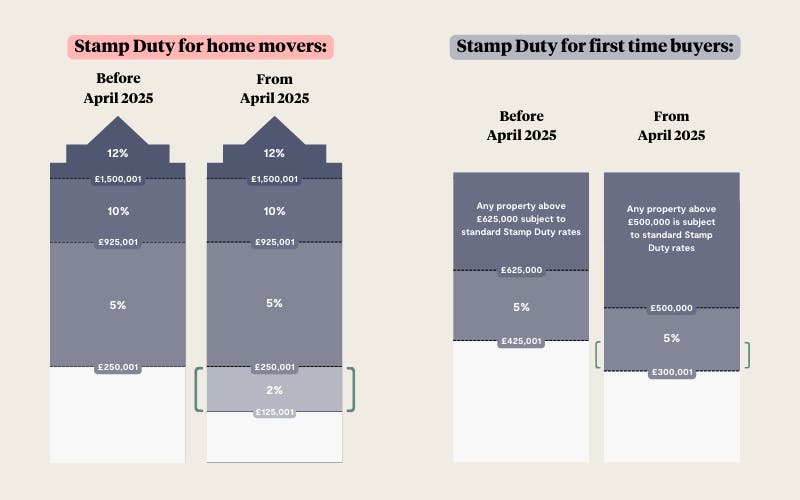
From 1st April 2025, the Stamp Duty thresholds for those moving up the ladder have dropped to £125,000 - meaning any portion of a property's value over this you'll pay Stamp Duty on. For first-time buyers, the threshold has dropped to £300,000, so anything over that you'll pay Stamp Duty on.
Home movers:
| Property price band | SDLT rate |
|---|---|
Up to £125,000 | 0% |
£125,001 to £250,000 | 2% |
£250,001 to £925,000 | 5% |
£925,001 to £1,500,000 | 10% |
Over £1,500,000 | 12% |
First-time buyers:
| Property price band | SDLT rate |
|---|---|
Up to £300,000 | 0% |
£300,001 to £500,000 | 5% (on the amount above £300,000 only) |
Over £500,000 | Standard home mover rates apply — no first-time buyer relief |
Since October 2024, the surcharge on second homes and buy-to-lets has increased from 3% to 5%.
Stamp Duty works in bands, so each rate only applies to the portion of the property's value that falls within that band. A Stamp Duty calculator can help estimate the total cost, and you can find out more about the changes to Stamp Duty in our blog here.
How is Stamp Duty calculated?
Stamp Duty is calculated using a banded system, similar to Income Tax. This means each rate only applies to the portion of the property price that falls within that band, rather than the full purchase price.
For example, if a home mover buys a £400,000 property:
- 0% on the first £125,000 = £0
- 2% on £125,001–£250,000 = £2,500
- 5% on £250,001–£400,000 = £7,500
- Total: £10,000
This is why it's important not to assume a flat rate applies to the whole purchase price. A Stamp Duty calculator can help compare costs.
Do buy-to-let owners pay stamp duty?
Yes. Buy-to-let purchases are charged at the standard Stamp Duty rates, plus an additional 5% surcharge (increased from 3% in October 2024). The amount of Stamp Duty you pay depends on the property's price:
| Property Price Band | Buy-to-Let SDLT Rate (incl. 5% surcharge) |
|---|---|
Up to £125,000 | 5% |
£125,001 to £250,000 | 7% |
£250,001 to £925,000 | 10% |
£925,001 to £1,500,000 | 13% |
Over £1,500,000 | 15% |
Like standard Stamp Duty, these rates are applied in bands, so each rate only applies to the portion of the price that falls within that band, not the whole purchase price.
Who qualifies for stamp duty exemption?
There are certain situations where you may be exempt from paying Stamp Duty - including being a first-time buyer (up to a certain price threshold). However, the criteria for the following scenarios tend to be quite specific, so it's best to read up on the HMRC guidance or speak to an expert first.
These include:
- First-time buyers - subject to higher thresholds than second-time buyers.
- Building or construction companies buying an individual's home
- Employers buying an employee's house
- A local authority making compulsory purchases
- Property developers providing amenities to communities
- Companies transferring property to another company
- Charities buying for charitable purposes
- Right-to-buy properties
- Registered social landlords
- Crown employees
Explore your options
Complete your mortgage options with Tembo and book a call with one of our mortgage experts to discuss strategies tailored to your situation.
6 ways to reduce your stamp duty bill
There are a couple of different ways you might be able to legally reduce - or even completely avoid - stamp duty, or decrease the amount you have to pay when purchasing your home, from applying for stamp duty refunds, to agreeing on a lower property price with the seller of your new home, to even using specialist mortgage products.
Here are 6 different ways you might be able to avoid stamp duty...
1. Haggle on the purchase price
If you can convince the home seller to lower their asking price, you could potentially reduce your stamp duty bill. You'll obviously save money on the price of the property, too!
One smart approach is to target Stamp Duty thresholds when making an offer. For example, if a property is listed just above £300,000, negotiating the price down to £300,000 or below could mean a first-time buyer pays no Stamp Duty at all. This is especially important around the £500,000 mark, if a first-time buyer's property costs even a penny over this, they'll lose all first-time buyer relief entirely.
To learn more, take a look at our guide to negotiating house prices.
If you're buying in a popular area where the market is fast-paced, this tactic is less likely to work. Offering the seller less than they've asked for might inspire them to accept someone else's offer instead. So if you have spotted your dream home, haggling to save money on stamp duty might not be worth the risk!
Can buying just below a Stamp Duty threshold save money?
Yes, small price differences near Stamp Duty band boundaries can produce outsized savings.
- £500,000 (first-time buyers): Above this, all first-time buyer relief is lost. Buying at £499,999 instead of £506,000 could save over £5,000.
- £250,000 and £925,000 (home movers): Rates step up from 2% to 5% and 5% to 10% respectively.
It can be worth raising this with the seller and using a Stamp Duty calculator to compare side-by-side costs.
2. Ask for new-build incentives
Buying a new build? Some developers offer various discounts and benefits in an attempt to attract buyers. If the house you're buying is above the stamp duty threshold, ask the developer if they'll pay your stamp duty for you. The worst they can say is no, and you'll be no worse off than if you didn''t try!
3. Pay for fixtures and fittings separately
If the seller is willing to leave items such as carpets, curtains, ovens or furniture behind when they move out, make sure the cost of these fixtures and fittings hasn't been factored into the property price. This will only make your stamp duty bill higher.
You could always offer to pay for these items separately so they're not taxable. It's a good idea to speak to a solicitor about this before making any arrangements with the sellers. HMRC demands this is done on a 'just and reasonable basis', so you don't want to take things too far.
4. Transfer a property
If you've been gifted a property or someone's left you their home in their will, you won't have to pay stamp duty on its market value as long as the title deeds have been transferred to you.
However, there's an important consideration to keep in mind. If you've been transferred just a share in a property (say, for example, you and your sister have inherited a house together) and you take on the responsibility for some or all of the mortgage, stamp duty may be payable.
5. Apply for a stamp duty refund
If you've bought a second home in the last few years but you'd like to sell your first one, you may be able to get a refund on some of the stamp duty you've paid.
Let's imagine you're struggling to sell your existing home, but you're in a position to buy a second one. You'd have to pay an extra 5% stamp duty additional home surcharge when purchasing your new home, even if you plan to sell the first one as soon as possible.
Thankfully, there's a rule which lets you claim back that 5% surcharge if you sell your first home within three years of buying the second one.
6. Add a Booster to your mortgage
If you'd like to buy a house with your partner but only one of you is a first-time buyer, you won't be eligible for the first-time buyer stamp duty relief. However, there is a way around this if one of you becomes a Booster
An Income Boost helps first-time buyers get on the property ladder by adding a friend or family member's income to the mortgage application. It's a popular option for single people looking to buy a home with their parents' help, but couples can use it to reduce their stamp duty bill without getting another family member involved.
Here's how it works: the second-time buyer will act as the first-time buyer's booster or guarantor instead of buying it together as joint owners.
- Although the booster will be named on the mortgage, they won't be named on the property deeds.
- The booster wouldn't contribute to the monthly payments or the house deposit, except if the owner needed help covering their mortgage payments.
- The booster won't be classed as a co-owner in the property or have an equity stake in the home.
This might not suit everyone, however, because the booster won't be classed as a co-owner in the property or have an equity stake in the home. But it's worth considering if you're concerned about a hefty Stamp Duty bill.
Learn more: First-time buyer buying with a homeowner: What are the restrictions?
What if stamp duty can't be reduced?
Unfortunately, Stamp Duty is often unavoidable, especially when buying an expensive property. While you may not be able to avoid a hefty Stamp Duty bill, there are plenty of other ways to reduce costs, such as negotiating on the property price and paying for additional elements separately.
Can stamp duty be offset against other taxes?
Stamp Duty generally cannot be offset directly against Income Tax or Corporation Tax. However, for landlords, SDLT paid on an investment property is usually treated as part of the acquisition cost when calculating Capital Gains Tax (CGT) on a future sale. Tax rules can vary by situation, so professional advice is recommended.
When does stamp duty need to be paid?
In England and Northern Ireland, an SDLT return is usually filed and any SDLT due is paid within 14 days of completion. A solicitor or conveyancer commonly submits the return and arranges payment, but the buyer remains responsible for meeting the deadline and avoiding penalties and interest.
Ready to start your journey?
Get started with Tembo and we'll help you navigate Stamp Duty and find the best mortgage for your needs.