




What is a Joint Borrower Sole Proprietor Mortgage?
 Ruth Henson, Guarantor mortgage specialist
With the number of first-time buyers lower than in previous years due to affordability pressures, a Joint Borrower Sole Proprietor mortgage is a great solution for would-be buyers struggling to buy on their own. A Joint Borrower Sole Proprietor Mortgage is a way to increase the amount you can borrow by adding a friend or family member's income to your mortgage application.
Never heard of a JBSP mortgage? No worries, they're becoming an increasingly popular option for first-time buyers and families, and this guide covers everything you need to know.
In this guide
- Key takeaways
- What is a Joint Borrower Sole Proprietor mortgage?
- How does a Joint Borrower Sole Proprietor mortgage work?
- What's the difference between a Joint Borrower Sole Proprietor and a joint mortgage?
- When would my guarantor come off the mortgage?
- How do I remove a joint borrower from a JBSP mortgage?
- Are JBSP mortgages more expensive?
- Does a JBSP mortgage affect the joint borrower's credit score?
- Can I get a JBSP mortgage with bad credit?
- What happens if my guarantor dies?
- What is the maximum age limit for a Joint Borrower Sole Proprietor mortgage?
- Can my guarantor live in the property with me?
Key takeaways
- Boost affordability: A buyer can combine their income with a family member or friend to increase the total amount they can borrow.
- Sole ownership: Only the primary buyer is named on the property deeds, meaning they remain the "sole proprietor."
- Shared liability: The guarantor is legally responsible for mortgage payments if the primary buyer cannot pay.
- Age restrictions: Mortgage terms are often limited by the age of the oldest applicant (usually must be repaid by age 75-80).
What is a Joint Borrower Sole Proprietor mortgage?
A Joint Borrower Sole Proprietor mortgage is a way for a family member or friend to help a home buyer increase their affordability, without handing over any cash. It's technically an arrangement rather than a specific mortgage product, meaning it's a structure that can be applied across a range of mortgage deals from different lenders.
You can have up to four people on a Joint Borrower Sole Proprietor mortgage application to boost how much you can borrow. So if you're buying with a partner, you could add two others as 'guarantors', or up to three others if you're buying on your own.
How does a Joint Borrower Sole Proprietor mortgage work?
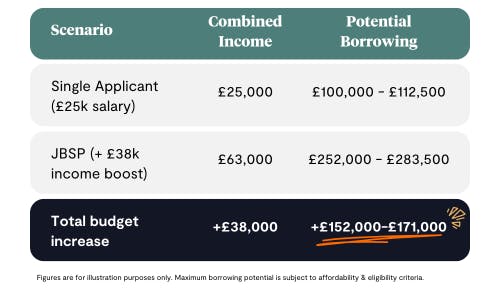
By adding a loved one or friend's income to your application through a Joint Borrower Sole Proprietor mortgage, your borrowing ability will be based on your income and theirs, instead of just your own. This allows you to boost what you could borrow for a mortgage, without having to put down a bigger deposit. This is a particularly good option for buyers who are still early on in their careers, so might be on lower salaries for the next few years, but expect their earnings to rise.
It's worth keeping in mind that because all borrowers share liability, missed payments can affect everyone's credit records. So it's important to only enter into a JBSP arrangement with someone you trust. The good news? Once the initial fixed deal period ends, the sole owner may be able to remortgage in their own name, removing the other borrowers from the mortgage entirely.
Only the buyer will own the property (as the "sole proprietor"), but your loved one (the guarantor) will be on the mortgage as a "joint borrower", meaning they will be liable to pay the mortgage if you cannot.
Is a JBSP mortgage right for you?
At Tembo, we call Joint Borrower Sole Proprietor mortgages Income Boosts. This is because an Income Boost increases the amount that the buyer could afford because the application is based on a higher combined income. Our team of experts could help you understand if this is the right choice for you.
Learn more: The ultimate guide to guarantor mortgages
You might also like: Buying a house on your own: How to do it and is it right for you?
Joint Borrower Sole Proprietor Mortgages can work out as a cheaper and more convenient option for parents or grandparents trying to help sons, daughters and grandchildren onto the housing ladder.
What is a Joint Borrower Sole Proprietor mortgage?
What's the difference between a Joint Borrower Sole Proprietor and a joint mortgage?
The key difference between a Joint Borrower Sole Proprietor mortgage and a Joint Mortgage is who is classed as a property owner. With a joint mortgage, all people named on the mortgage are property owners, as well as being equally responsible for repaying the mortgage. This can be a good option if you want to buy with a friend, sibling or parent. Whereas with a Joint Borrower Sole Proprietor mortgage, your loved one who is added onto the mortgage as a guarantor won't be a property owner, but will still be liable for the mortgage payments.
Because the supporting borrower isn't named on the property deeds, they typically don't have to pay the additional stamp duty surcharge that can apply to those who already own a property, which can be a big financial advantage.
Which one is right for you depends on whether you want the person who is supporting your application to own some of the property with you or have purely a supportive role. It's a good idea to get expert advice from a mortgage expert to discuss each option and work out what's best for you and your family.
Pros and cons of JBSP mortgages
Pros
Having a higher income, boosted by a loved one may mean the homebuyer can achieve their homebuying dream with a smaller deposit. This can mean they are able to buy a property sooner, potentially saving thousands of pounds in rent.
Can be a good alternative to a typical joint mortgage. In both cases, all parties are equally responsible for repaying the mortgage. But with a JBSP mortgage, because only the homeowner has their name on the property deeds, only they benefit from its value. This means that the other parties don’t usually have to pay capital gains tax or the 3% stamp duty surcharge.
Cons
All borrowers on the mortgage application will need to pass a credit check. Even if a parent is a higher earner and wants to help boost the income of their son or daughter to help them on the property ladder, if they are overcommitted with their own borrowings and outgoings – maybe their own mortgage is still big, or they have a lot of credit card debt – that will be a problem.
All of those named on the mortgage application will be liable for repaying the mortgage, but only the homeowner has any rights to the value of the property. So parents (or grandparents) who put their income at risk in this way will have no corresponding rights.
Exiting a JBSP mortgage can be complicated, particularly if your relationship with the other borrowers changes. The supporting borrower typically can't be removed until the homeowner can afford to remortgage in their own name, which may take several years.
When would my guarantor come off the mortgage?
Your guarantor can come off the Joint Borrower Sole Proprietor mortgage once you can afford to take on the mortgage independently. This typically happens when your income has increased enough that you meet the lender's affordability criteria on your own.
In practice, the most common way to remove a guarantor is by remortgaging into the homeowner's sole name once the initial fixed deal period ends and early repayment charges no longer apply. The guarantor would also come off the mortgage if the homeowner chooses to sell the property.
How do I remove a joint borrower from a JBSP mortgage?
To remove a joint borrower from a JBSP mortgage, the sole proprietor typically needs to remortgage into their own name. This usually happens once their income has grown enough to meet a lender's affordability requirements on their own. The lender will carry out a fresh affordability assessment, and if the sole proprietor passes, the joint borrower can be released from the mortgage. Most people choose to do this at the end of their initial deal period to avoid early repayment charges. A mortgage adviser can help work out the right time to make the switch and which lenders will allow it.
Are JBSP mortgages more expensive?
Not always. Some lenders price JBSP mortgages the same as their standard products, while others charge slightly higher rates. The difference will depend on the lender, the loan-to-value (LTV) ratio, and the combined financial profile of all borrowers on the application. Because JBSP mortgages are offered by a smaller pool of lenders than standard mortgages, it's worth speaking to a specialist mortgage adviser to compare the full market and find the most competitive deal available.
Does a JBSP mortgage affect the joint borrower's credit score?
Yes, it can. Because all parties on a JBSP mortgage are jointly liable for repayments, any missed or late payments will show on everyone's credit record, not just the sole proprietor's. This means the joint borrower's credit score could be affected even if they didn't personally miss a payment. Before agreeing to become a joint borrower, it's important for both parties to understand this risk and feel confident that repayments can be met each month consistently.
Can I get a JBSP mortgage with bad credit?
It depends on the severity of the credit issue and the lender. All borrowers named on a JBSP mortgage, including the joint borrower, go through a full credit assessment. Some lenders are more flexible than others when it comes to adverse credit history, such as missed payments, defaults, or a low credit score. Because criteria vary widely between lenders, speaking to a specialist mortgage adviser is the best way to find out which lenders are most likely to consider the application and on what terms.
What happens if my guarantor dies?
If the joint borrower passes away, the lender will reassess whether the sole proprietor can afford the mortgage on their own. If they can, the buyer may be able to remortgage into their own name and continue as normal. If they can't cover the repayments alone, they may need to sell the property or find another eligible joint borrower to add to the mortgage. It's worth speaking to a mortgage adviser as soon as possible if this situation arises, as options will vary by lender.
What is the maximum age limit for a Joint Borrower Sole Proprietor mortgage?
The length of the mortgage term the homeowner is allowed will depend on the age of the oldest person named on the application. Most lenders require a mortgage to be paid off by age 80, though some lenders extend this to age 85. So if you want to take out a 35-year mortgage term, your guarantor can be no older than 45, for example. This may limit your term if the support is coming from a parent or grandparent, and so make monthly repayments higher. For more details, see our guide on the age limit for Joint Borrower Sole Proprietor mortgages.
Joint Borrower Sole Proprietor Mortgages can work out a cheaper and more convenient option for parents or grandparents trying to help sons, daughters and grandchildren onto the housing ladder.
"If your parents would prefer to contribute to your deposit, they could use a Deposit Boost mortgage instead. This unlocks money from your family member's existing property and uses that cash to either top up your deposit or create one from scratch."

Ruth
Senior Mortgage Advisor & Guarantor Mortgage specialist at Tembo
Can my guarantor live in the property with me?
No. Most lenders require that only the sole proprietor, the person who owns the property, lives there. The joint borrower (the guarantor) must live elsewhere. If a joint borrower does live in the property, lenders will typically treat the arrangement differently, and the number of lenders willing to offer a JBSP mortgage becomes much more limited. This is one of the key conditions that separates a JBSP mortgage from a standard joint mortgage.
Which banks offer Joint Borrower Sole Proprietor mortgages?
| Lender type | Lenders |
|---|---|
High-Street & Major Banks | Virgin Money, Nationwide, Bluestone, Clydesdale Bank, Post Office Money |
Specialist & Building Societies | Norton Home Loans, Dudley Building Society, Skipton Building Society, Melton Building Society |
It's also worth knowing that even if one of the borrowers has a less-than-perfect credit history, there may still be JBSP options available. Different lenders assess credit differently, so working with a specialist broker can help find the right match.
This list of lenders is non-exhaustive and could change at any time. Each lender will have its own criteria and restrictions on who it will lend to using a JBSP mortgage, and under which rules. For the most up-to-date information and to see all of your options, it’s a good idea to speak to a specialist about JBSP mortgage deals.
Speak with the experts
At Tembo, we specialise in finding mortgage options that could boost your budget and help make home happen, even when homeownership feels out of reach. Our expert mortgage brokers assess your individual circumstances and provide tailored advice and recommendations to help you navigate your homebuying journey with confidence.