






Why is it hard for first-time buyers?
 Anya Gair
It is harder for first-time buyers to get onto the property ladder today compared to previous generations and it comes down to a combination of rising house prices, wages that haven't kept pace, high living costs eating into savings, and strict mortgage lending criteria. The good news? There are practical steps first-time buyers can take to finally make home happen. This guide breaks down exactly why it's so tough and, more importantly, what to do about it.
Key Takeaways
- Affordability gap: UK house prices growth has far exceeded the growth in wages.
- Deposit hurdles: The average first-time buyer deposit is now £42,324, often requiring over a year's total take-home pay.
- Government support: Using a Lifetime ISA (LISA) can provide up to £1,000 in free government bonuses annually, helping buyers enter the market nearly 3 years sooner.
- Borrowing solutions: Specialist schemes like Income Boosts and Deposit Boosts can increase borrowing potential by an average of over £82,000.
- Alternative paths: Shared Ownership and higher lending schemes (5x or 6x salary) offer routes for those struggling with standard 4.5x income multipliers.
For more guides and expert advice on your first house purchase, head to our First-Time Buyer Hub.
Get expert help
There are many things to wrap your head around when you get your first mortgage, no-one can blame you for getting confused! That's where Tembo come in. Our team of experts can help you understand your options, complete you mortgages options to book a call.
Why is it so hard for first-time buyers to afford a home?
Today, first-time buyers are facing a two-sided problem. House prices have risen substantially over the last few decades, outpacing wage growth. At the same time, first-time buyers are also having to contend with high living costs, even on a good salary. This is making it harder to save enough money for the down payment on a home, as well as borrow enough for a mortgage when house prices are 7x incomes.
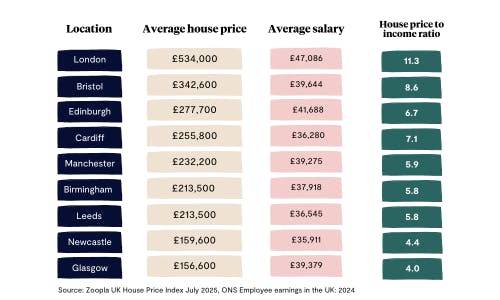
Currently, the average UK house price is just under £270,000, meaning that a first-time buyer wishing to put down a 10% deposit would need to save almost £27,000. But for some first-time buyers, they’ll need to save substantially more than this. First-time buyers in London hoping to put down 10% will need £53,000, based on the average home costing £530,000.
While in Newcastle, one of the most affordable locations in the UK, the average home is £158,000, making a 10% deposit £15,800. That's certainly more manageable than London, but it's still no small sum to save up.
Here’s a table which illustrates the difference between the average salary and average house price in different parts of the UK:
The "cost of living" crisis has disproportionately impacted younger generations through several key factors:
- High fixed costs: Rising rent, utility bills, and groceries reduce monthly savings capacity.
- Student debt: Approximately 40% of millennials graduated from university and are paying monthly student loan repayments.
- Rent vs. buy gap: In London, rent consumes over 51% of take-home pay, leaving little room for deposit accumulation.
Not to mention rising property prices have pushed the amount needed for a deposit higher and higher. According to our First-Time Buyer Index, the average first-time buyer deposit now stands at £42,324 - more than a full year's take-home pay. While the average age at which first-time buyers buy their first home is 32, those using a Lifetime ISA are able to bring that timeline forward by almost three years.
But saving a deposit is only half the battle, with many first-time buyers struggling to borrow enough due to strict affordability criteria and high property prices. When you apply for a mortgage, the lender will carry out a series of checks to make sure you can comfortably afford your mortgage payments. The last thing anyone wants is for you to get into financial trouble and be unable to pay your loan.
Affordability criteria can vary from one lender to another, but your lender will usually want to see proof of income (in the form of pay slips or tax returns) and proof of your typical expenditure (bank statements).
Many lenders also use something known as ‘income multipliers’ to determine exactly how much to lend you. Most will multiply your income by 4 or 4.5 to get your total loan amount, meaning you may be eligible for a £200,000 to £300,000 mortgage if you have an income of £50,000. Yet we found that in many UK cities, the average loan-to-income ratio for first-time buyers is already above the standard 4.5x cap.
In London, that figure reaches 8.3, nearly double standard lending thresholds, and average rent consumes over 51% of take-home pay, leaving almost nothing left to save.
If you’re unable to get a mortgage big enough for the home you want or you’ve been rejected completely, here are a few ways to boost your affordability, which we cover below.
Learn more: Why are banks tightening their lending standards?
Why are house prices so high in the UK?
Put simply, house prices are so high because demand for homes has consistently outstripped supply, while wages haven't kept up. Since the 1970s, house prices in the UK have risen significantly, outpacing wages. A major driver of this is a chronic shortage of new housing. It's estimated that there are 4.3 million homes missing from the UK housing market.
This means that over time, the homes that are on the market have gone up in value quicker than wages, making getting on the ladder more and more unaffordable.
However, affordability is improving for first-time buyers. We found that Q1 2026 has a First-Time Buyer Attractiveness Score, a composite measure of affordability, mortgage availability, and market conditions, of 637 out of 1,000. While this reflects some improvement from recent lows, this doesn't mean that structural barriers preventing the majority of aspiring buyers from purchasing have disappeared.
Boost your affordability
Tembo are a whole-of-market mortgage broker who can access over 100 lenders to help find the right deal for you based on your circumstances. We boost budgets by an average of £82,000
What solutions are there for first-time buyers?
Saving a deposit can be really challenging, no matter where you live. But the good news is that there are government-backed savings products, specialist mortgage schemes, and family-assisted options that can make a real difference. From Lifetime ISAs to income-boosting mortgages, here are some of the most effective ways first-time buyers can get onto the ladder sooner.
And it's worth speaking to a mortgage expert early on, understanding what's available before committing to a savings or buying strategy can save time and money in the long run.
1. Open a Lifetime ISA
If you’re saving for your first home, a Cash Lifetime ISA (LISA) can help you boost your deposit by up to £1,000 each tax year for free - and you’ll earn interest on top.
You can save up to £4,000 in your LISA each tax year and get a 25% bonus from the government on any funds deposited. So if you can’t deposit the full £4,000, you don’t worry as you’ll still earn 25% on top of whatever you save. You can open a Tembo LISA today with as little as £1!
Yet despite this, only 17% of first-time buyers are currently using a Lifetime ISA, according to our analysis - meaning the majority are missing out on an estimated £3,000–£5,000 in free government support. Those who do use a Lifetime ISA to buy their first home do so an average of 2.8 years earlier than those who don't (average age 29.2 vs 32).
Keep in mind that you can only use your Lifetime ISA funds for your first house deposit for a home worth no more than £450,000, or for retirement. If you buy a more expensive home or make a withdrawal before the age of 60 for anything other than an eligible property, you’ll pay a 25% withdrawal penalty.
When considering opening a LISA, remember that withdrawals for any purpose other than buying a first home or for retirement will incur a 25% government penalty, meaning you may get back less than you paid in. Tax treatment depends on individual circumstances and may be subject to change in the future.
2. Consider a Shared Ownership scheme
Another option is Shared Ownership, which you can use whether you have a Lifetime ISA or not. Shared Ownership is a part buy, part rent buying scheme that lets you buy a percentage of a property and pay rent on the rest. As you’re not buying the property ‘in full’, you’ll need a much smaller deposit and mortgage than you usually would. You can then increase your share of the property over time, making it easier to transition from renter to homeowner without having to save a 10% deposit for the full property price upfront.
Perfect for you: What is shared ownership and how does it work?
3. Boost your deposit with family support
If a homeowning friend or family member wants to help you buy a home of your own, a Deposit Boost could be the answer. It typically involves remortgaging their home to release money tied up in their property, the proceeds of which you can then put towards your house deposit. If you have savings of your own, you can include them too in your deposit, or put them towards other homebuying costs such as conveyancing fees or Stamp Duty, if applicable.
Plus, by putting down a bigger deposit, you can often access better interest rates by lowering your Loan to Value (LTV), which could lower your mortgage payments, making them more affordable.
A Deposit Boost is just one of many low-deposit mortgage options. Complete your mortgage options with Tembo today to find out which first-time buyer schemes are most suitable for you from across the market without applying.
In practice, we found that first-time buyers who accessed specialist affordability schemes - including Income Boost and Deposit Boost - increased their maximum borrowing potential by an average of £88,399, lifting budgets from £271,484 to £390,817.
4. Add a loved one’s income to your mortgage
If you’re struggling to borrow enough for the home you want, an Income Boost could be the answer. Officially known as a ‘Joint Borrower Sole Proprietor’ mortgage (you can probably see why we don’t call it that), an Income Boost lets you add some or all of a loved one’s income to your mortgage application. This helps to boost your affordability by increasing the total income lenders will then use to work out how much to lend you. This is how an Income Boost can help you get a bigger mortgage.
An Income Boost can significantly increase your buying power. For example:
| Scenario | Income | Max Loan (4.5x) |
|---|---|---|
Buying alone | £30,000 | £135,000 |
With "Booster" (e.g., Parent) | £80,000 (Combined) | £360,000 |
Although your ‘Booster’ will be added to the mortgage, they won’t be named on the property itself. They also won’t need to contribute to your monthly repayments automatically. But if you’re unable to keep up with your mortgage yourself, they will be required to help.
5. Look at higher lending schemes
For some borrowers, they may be able to increase what they can borrow for a mortgage through higher lending schemes, helping them to borrow 5 or even 6 times their income. These schemes include Professional Mortgages for roles such as accountants and solicitors, Key Worker and NHS Mortgages, as well as 5x Mortgages and 6x Mortgages for borrowers who meet certain criteria, such as earning a certain income.
6. Make your mortgage more affordable
Lenders have a responsibility to only offer mortgages to those who can afford to pay them back, but even so, some borrowers find that their mortgages become less affordable over time. This can be due to rising interest rates, a change in their income, or a breakup/divorce, for example. There are a few ways to protect yourself, for example you could lengthen your mortgage term, or switch to an interest-only mortgage.
Back in the day, most mortgages came with a 25-year term, but as property prices have risen (and wages have failed to keep up), terms of 30, 35 and even 40 year mortgage terms have become a lot more common. Spreading your mortgage over a longer term will help to reduce your monthly repayments and could increase your affordability, but be aware that by doing this, you’ll also spend more on interest in the long run.
Switching to an interest-only mortgage can be another way to make monthly payments more affordable in the short term. Instead of paying off some of the mortgage loan and interest each month, the borrower only pays back the interest. This can significantly reduce monthly outgoings.
However, it's important to keep in mind that the full mortgage loan will still need to be repaid at the end of the term. Unless the borrower switches back to a capital repayment mortgage at some point, the original debt won't shrink. That's why interest-only mortgages are generally best viewed as a short-term solution during periods of financial pressure.
Check your eligibility
When you complete your mortgage options with Tembo, we compare your eligibility to schemes like these, as well as thousands of mortgages from across the market.